
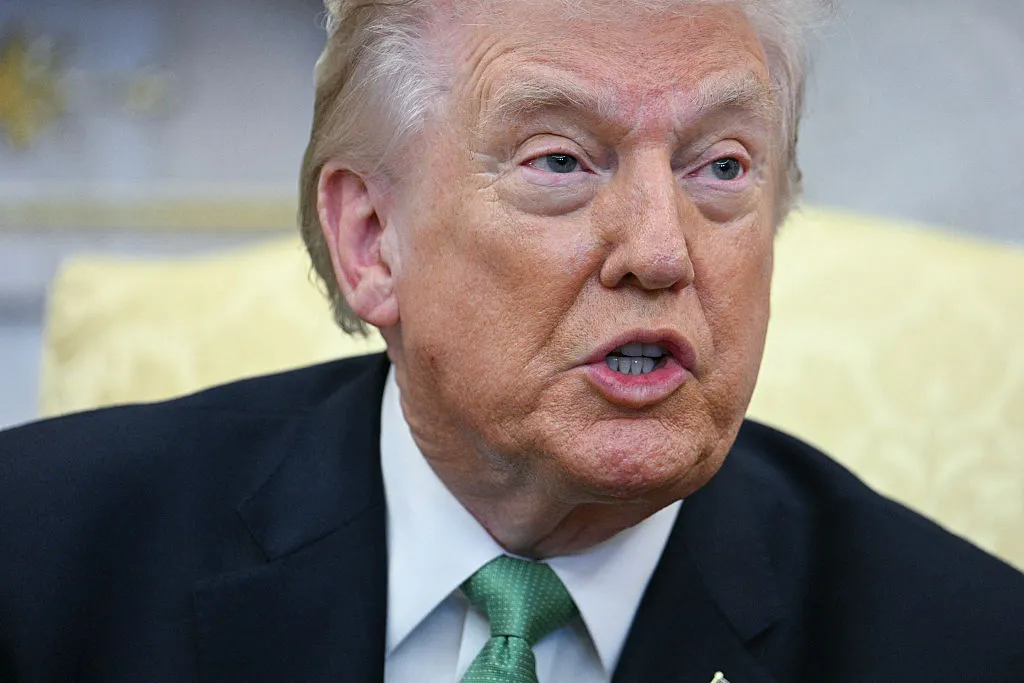
As criticism of Donald Trump continues to grow over the administration’s escalating conflict with Iran, the president has once again shifted attention in a way that feels all too familiar — by making inflammatory comments about entire groups of people and invoking rhetoric that critics say echoes the language of eugenics.
During a radio interview released this week, Trump responded to a series of recent violent attacks across the United States by blaming what he described as the “genetics” of the people responsible. The remarks came after violent incidents at a university in Virginia, a synagogue in Michigan, and an attempted attack near Gracie Mansion in New York City.
“They’re sick people,” Trump said in the interview. “Something’s wrong there. The genetics are not exactly your genetic.” He then went on to suggest that many of the individuals responsible had been allowed into the country by previous administrations, once again linking violent crime to immigration without providing evidence.
Critics quickly pointed out that this is not the first time Trump has used this type of rhetoric. Over the past several years, he has repeatedly suggested that migrants are more likely to commit violent crimes and has framed the issue in terms of “bad genes,” a phrase that has drawn strong backlash from historians and civil rights advocates.
The language has also raised concerns because of its historical associations. The idea that certain groups are naturally predisposed to violence has long been connected to the eugenics movement, which promoted the idea that some people were genetically superior to others. For many observers, hearing a sitting president talk about crime in terms of genetics is deeply troubling, especially given the broader political climate.
Trump has frequently responded to criticism of his rhetoric by doubling down rather than backing away from it. In previous interviews and speeches, he has made similar claims about immigration, often blaming his political opponents for allowing what he describes as “dangerous people” into the country.
The latest remarks have also come at a time when the administration is facing intense scrutiny over foreign policy decisions, particularly the military conflict with Iran. Some critics argue that comments like these are an attempt to redirect attention away from that controversy and shift the focus back to immigration and domestic security — two issues that have long been central to Trump’s political messaging.
Supporters, meanwhile, have defended the president’s comments as an attempt to highlight the seriousness of violent crime. But for many others, the language used in the interview crossed a line once again, reinforcing concerns about the tone and direction of the country’s political leadership.
Whether the backlash will have any long-term political impact remains to be seen. What is clear, however, is that Trump’s remarks have once again reignited a debate about how political leaders talk about crime, immigration, and race — and how those words can shape public perception far beyond a single interview.
